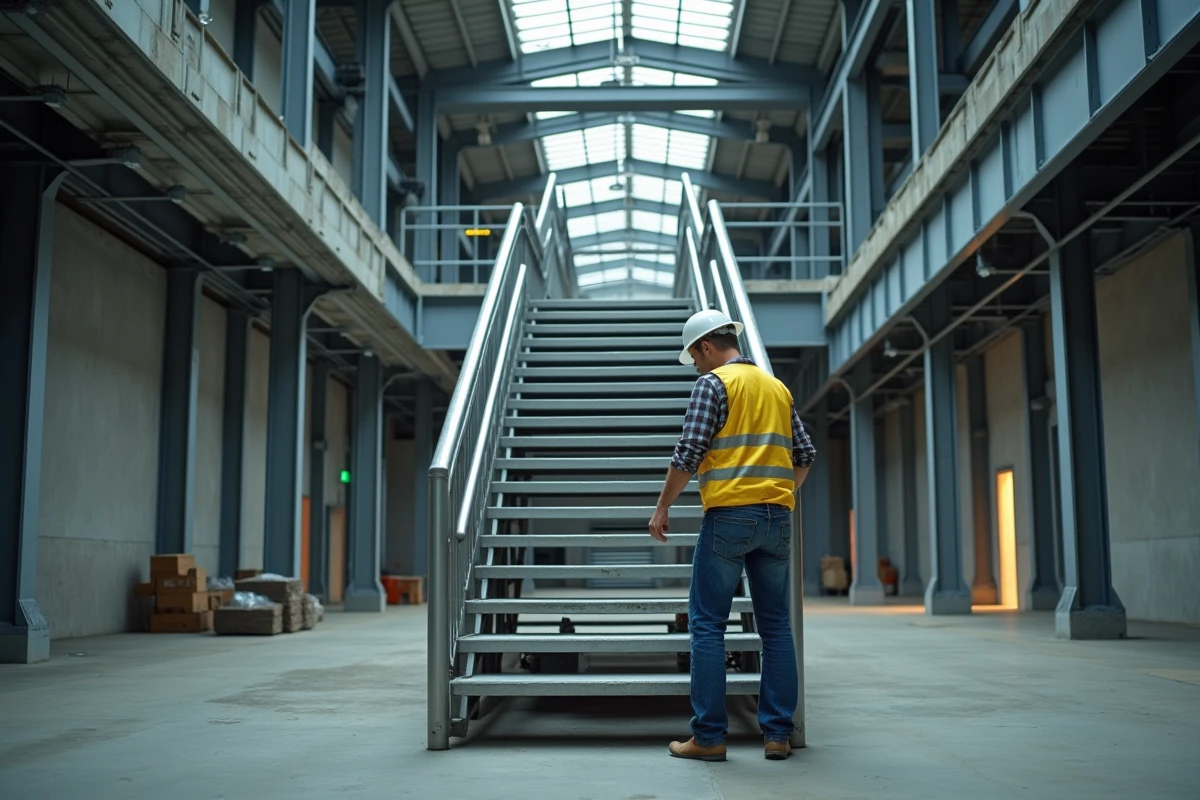
Stairs in establishments open to the public (ERP) face contradictory requirements: regulatory accessibility, structural resistance, and, recently, pressure on the environmental impact of the materials used. The issue of foundation beams, often relegated to the background in renovation projects, alters the technical and financial equation of these structures.
Carbon footprint of ERP stairs: what traditional materials really weigh
Reinforced concrete remains the dominant material for ERP stairs and their foundation beams. Its production generates a significant share of CO2 emissions in the construction sector, due to the calcination of calcite during the manufacture of Portland cement.
In renovation projects, the carbon weight accumulates: demolition of the existing structure, transport of debris, pouring of new beams, and then manufacturing and installation of the stairs. Each step increases the overall footprint without project owners always having reliable comparison tools between the different options.
Low-carbon alternatives are beginning to emerge. Low-clinker concretes, wood-metal hybrid structures, and galvanized steel stairs are being tested on pilot sites. Their deployment remains limited by the regulatory framework, which imposes fire resistance and dimensional stability levels calibrated to the performance of traditional concrete.
The industry is also exploring the use of geopolymer binders for beams, with promising results in reducing emissions. However, field feedback is still too recent to draw conclusions about long-term durability.
A project that integrates an innovative design for ERP stairs and foundation beams from the design phase can arbitrate between these solutions based on the geotechnical context and the building’s regulatory constraints.
Galvanized steel versus concrete for ERP stairs in humid environments
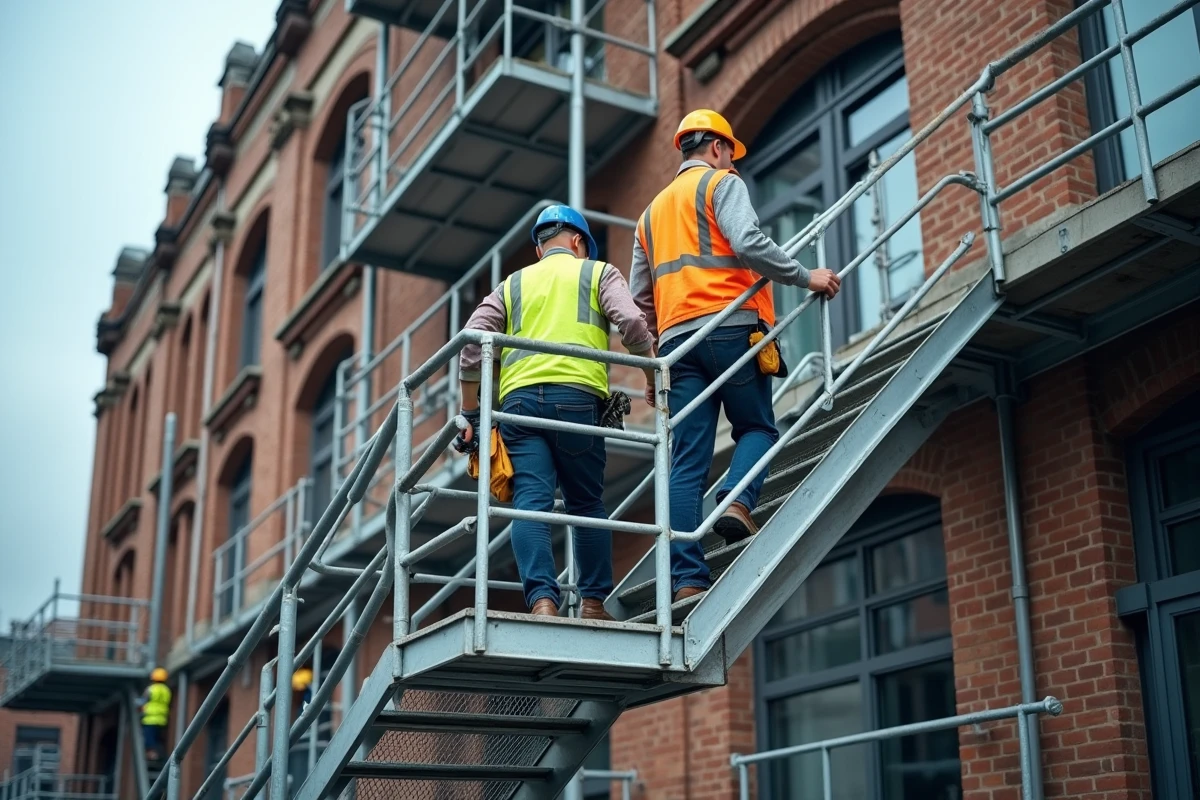
Accelerated aging studies show a clear trend: galvanized steel reduces maintenance costs in humid environments compared to concrete. The corrosion of reinforcements in concrete exposed to moisture (basements, outdoor access, coastal buildings) leads to costly structural issues, sometimes detected late.
Galvanized steel, on the other hand, presents a sacrificial zinc barrier that protects the structure for several decades. In the event of localized damage, repairs are limited to surface treatment, without foundation work.
This comparison is not a universal verdict. Concrete retains the advantage in fire resistance, a non-negotiable criterion in most ERPs. Metal stairs must then receive intumescent treatment or fireproof coating, which increases the initial cost and alters the overall economic calculation.
Criteria for choosing between the two sectors
- The fire rating required by the ERP category: a enclosed concrete stair is often the most straightforward solution for category 1 and 2 ERPs.
- Exposure to moisture or chemical agents: underground parking, public pools, coastal buildings steer towards galvanized steel.
- The maintenance budget over twenty years: incorporating the cost of repairing degraded concrete changes the hierarchy of options.
- The carbon footprint of the project: recycled steel has a lower carbon footprint than new concrete, provided the traceability of the raw material is verified.
Foundation beams in seismic zones: field feedback from Occitanie
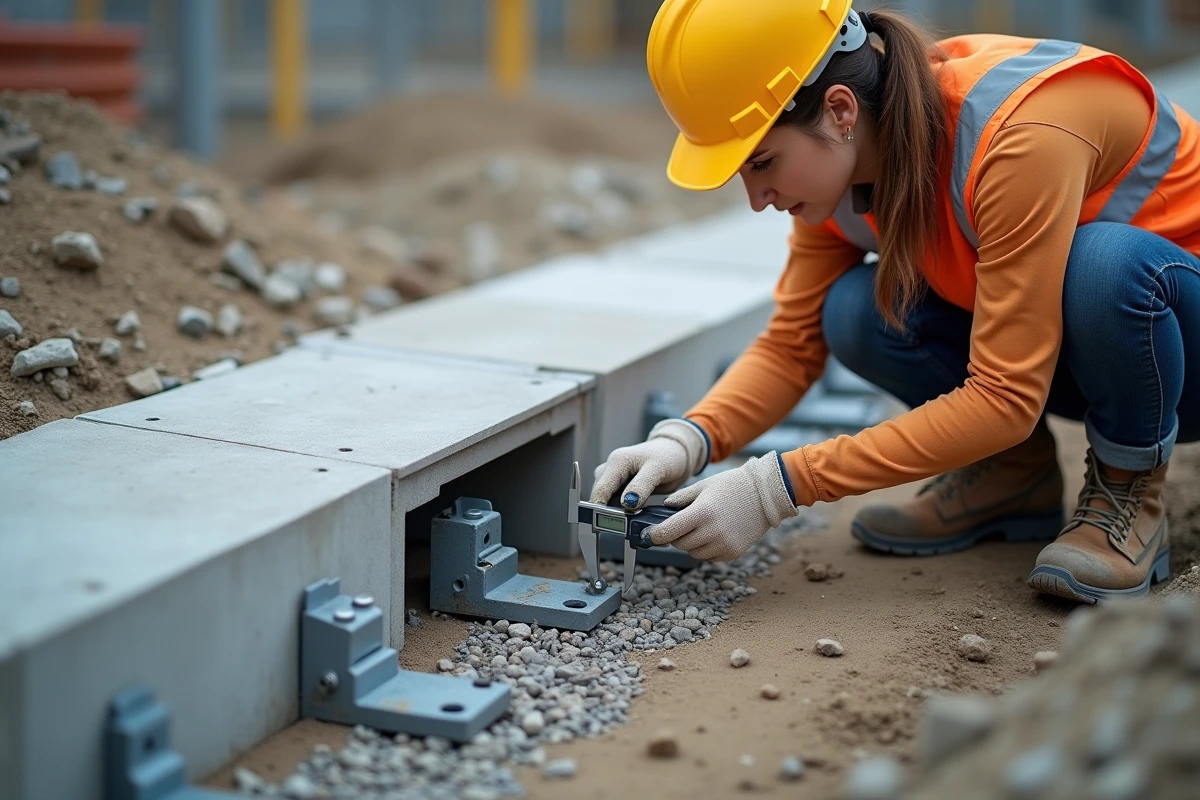
Reported cases in Occitanie document post-installation adjustments on foundation beams designed for innovative ERP stairs. These feedbacks highlight a rarely anticipated point: the dynamic behavior of beams under seismic stress differs according to soil type.
On expansive clay soils, common in southern France, traditional reinforced concrete beams experience differential settlements that misalign the stairs. Post-installation corrections (resin injection, underpinning) can increase the budget by several tens of percent compared to the initial estimate.
Solutions that work better in these contexts combine beams on micropiles with semi-rigid connections that allow for partial absorption of soil movements. This technical approach is still poorly documented in current normative guides, complicating the task for engineering firms during sizing.
Regulatory framework for ERP and real margin for innovation
The decree of April 20, 2017 (article 7-1, R. 111-19-2) sets the minimum characteristics for ERP stairs: minimum width of 1.20 m between handrails, step height less than or equal to 16 cm, tread greater than or equal to 28 cm. These dimensions apply whether or not the building has an elevator.
The margin for innovation therefore lies elsewhere than in the geometry of the stairs, which remains locked. It focuses on three axes:
- The choice of structural and foundation materials, for which regulations impose performance standards (fire resistance, stability) without prescribing a specific material.
- The integration of warning strips and visual contrasts in bio-sourced or recycled materials, replacing conventional plastic products.
- Off-site prefabrication of stair flights and beams, which reduces construction nuisances and intervention time in operational ERPs.
Prefabrication and reduction of construction footprint
Workshop prefabrication allows for quality control of low-carbon concrete or metal structures under optimal conditions. Transport and installation take only a few hours, compared to several days for on-site pouring. For ERPs that cannot close during construction, this approach represents a significant operational advantage.
Field feedback diverges on one point: the junction between prefabricated elements and existing foundations. Acceptable dimensional tolerances in the workshop do not always correspond to the reality of old buildings, necessitating adjustments on site and diminishing the expected time savings.
The arbitration between materials, installation methods, and regulatory compliance does not resolve with a single solution. Each ERP stair project with foundation beams requires a cross-analysis of the soil, the classification of the establishment, and the environmental objectives of the project owner. The available data point towards a diversification of sectors, but the regulatory framework has not yet caught up with the technical innovations tested in the field.