When you work in a store or at a production site, time spent in front of a screen is scarce. Accessing the employee store between customers or during a break calls for a tool that gets straight to the point.
At L’Oréal, employee sales are among the benefits offered as soon as a new employee joins, including interns. The launch of a new dedicated site raises a practical question: does it really make shopping easier for frontline teams, or are the obstacles simply shifting to login, delivery or product availability?
L’Oréal employee store: what a mobile-first site changes
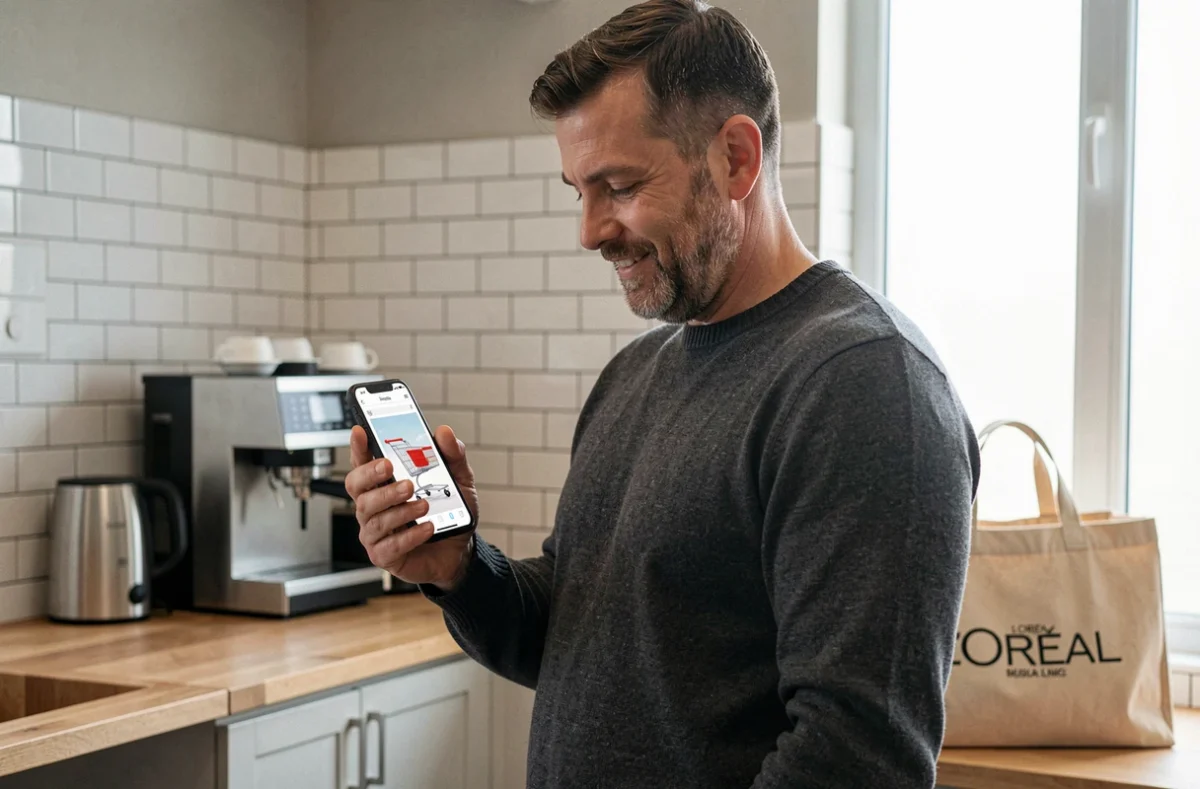
Most retail employees don’t have a fixed workstation. Their main tool is their phone. An employee store that doesn’t work well on mobile effectively shuts out part of the team.
With L’Oréal’s new employee store, the goal was to offer a shopping journey that could be completed in just a few minutes, without a computer. In practice, that means fast-loading pages, a catalog that’s easy to read on a small screen, and a checkout process stripped down to the essentials.
Mobile access determines how frontline teams actually use the site. A beauty advisor with ten minutes between appointments won’t open a complicated tool. They need to find a product, check the discounted price and place the order. Three steps, not fifteen.
L’Oréal also offers “Friends & Family” sales as part of this benefit, extending the site’s potential audience beyond employees alone. A smooth shopping journey also benefits users who are less familiar with the group’s internal environment.
Login and delivery: the real pain points for store employees
A fast site isn’t enough if logging in gets in the way. Have you ever tried to retrieve a work password on your personal phone between customers? It’s the kind of detail that can turn an employee benefit into a source of frustration.
Authentication and access without a fixed workstation
Store employees often use a work account that’s separate from their personal email. If the site requires complex authentication (a VPN or two-step verification tied to the internal network), some frontline teams are effectively shut out. Simplifying access means letting employees log in directly through a mobile browser, without an extra technical layer.
Delivery: home, pickup point or store
The choice of delivery method has a direct impact on the experience. Delivery to the store may seem logical, but not every location has a suitable space for receiving parcels. Home delivery, meanwhile, depends on the carrier’s reliability.
- Pickup-point delivery is the most flexible option for an employee whose workplace changes from week to week
- Store delivery avoids shipping fees, but requires the manager to agree to handle personal parcels on site
- Home delivery is the most convenient, provided delivery times are predictable and clearly communicated during checkout
Delivery options affect satisfaction just as much as the discounted price. A product at thirty percent off loses its appeal if it arrives two weeks late.
Inventory management and product availability on the employee store
An appealing catalog with half its products out of stock is a common problem with employee sales. An employee finds a skincare product or perfume, adds it to their cart, then discovers at checkout that it’s no longer available.
Real-time inventory updates are the most important technical requirement. Without them, the site creates disappointment instead of loyalty. If the same experience keeps happening, employees eventually stop checking the platform.
At L’Oréal, the brand portfolio spans mass-market beauty, luxury, dermocosmetics and professional haircare. Managing availability on a single site, with thousands of products, presents a real logistical challenge. Access to products may also vary by country or campus, as some of the group’s offers specify.
Empowering retail teams: more than just a shopping tool
Employee sales are about more than a financial benefit. For a beauty advisor, trying the group’s products is a form of ongoing training. Buying a new serum at a reduced price also helps them get to know it better so they can recommend it in store.
This approach builds on what L’Oréal has already introduced for its frontline teams with Microsoft Teams and the Turnos app. The stated goal was to create a unified work environment where collaboration and information sharing no longer depend on access to a desktop computer.
- Getting to know products means using them personally, which the employee store makes easier
- Collaboration between beauty advisors, already improved by mobile communication tools, continues when teams share their product discoveries
- Employees gain autonomy when they can manage their account, orders and returns without asking a manager or HR team for help
A well-designed employee store boosts operational autonomy by removing unnecessary intermediaries. Employees can place an order, track their parcel and manage any returns themselves. They stay in control at every step.
Training and onboarding
Introducing new employees to the employee store as soon as they start sends a clear message: the company shares the value it creates. This isn’t just talk; it’s direct access to products employees will sell or recommend every day.
Managers play an important role in supporting this process. Introducing the site during onboarding, explaining how to access it and highlighting special sale periods: these simple steps turn a tool into a habit.
L’Oréal’s employee store doesn’t reinvent online shopping. Its value lies in what it removes: unnecessary steps, duplicate forms and broken journeys that put off busy employees. The real measure of its success comes from frontline teams, one order at a time.